🦠 Advance Your Scientific Career:
(M.Sc.) in Microbiology
Embark on a transformative academic journey with the Master of Science (M.Sc.) in Microbiology program at Wellspring University. Designed to equip graduates with advanced theoretical knowledge, cutting-edge laboratory skills, and specialized research expertise, this program prepares you for leadership roles in the crucial fields of health, food security, industry, and environmental sustainability.
(M.Sc.) in Microbiology
At Wellspring University, we blend rigorous academic training with practical, industry-focused application, ensuring our graduates are ready to solve complex global challenges.
🦠 Advance Your Scientific Career:
Key Program Highlights
- Advanced Curriculum: Deepen your understanding of microbial sciences, moving beyond the fundamentals to master complex areas such as molecular diagnostics, epidemiology, microbial genetics, and bioinstrumentation.
- Research-Intensive: The program culminates in a mandatory dissertation/thesis, providing you with the opportunity to conduct original, supervised research and contribute new knowledge to the field of microbiology.
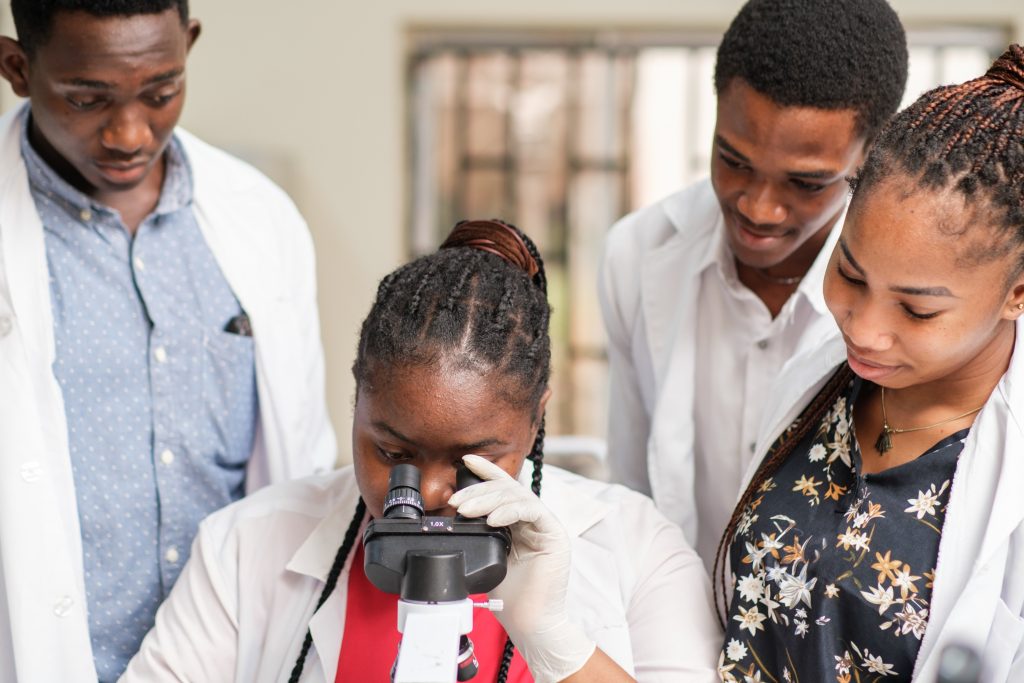
- Practical Skill Development: A strong emphasis is placed on hands-on laboratory training in techniques vital for modern science and industry.
🦠 Advance Your Scientific Career:
Flexible Duration:
The M.Sc. program typically runs for a minimum of two (2) academic sessions (4 semesters) full-time, with a maximum duration of up to three (3) sessions (6 semesters), allowing for comprehensive study and research.
🦠 Advance Your Scientific Career:
Key Program Highlights
While the program at Wellspring University offers a broad and comprehensive foundation, it is structured to cover the core areas that are vital for a modern microbiologist. Key course content areas typically include:
Core Specializations in Microbiology
The field is traditionally divided into sectors that address human health, industry, the environment, and agriculture. Here is how those core areas break down:
- Medical Microbiology: Focus on the identification and characterization of pathogenic bacteria, viruses, fungi, and parasites that cause human disease. This area explores host-pathogen interactions, the mechanics of the human immune system, and the critical study of antimicrobial resistance (AMR) to develop effective chemotherapy and treatment protocols.
- Food & Industrial Microbiology: Study the dual role of microbes as both beneficial tools and spoilage agents. This includes their application in large-scale fermentation and biotechnology to produce enzymes or biofuels, as well as the rigorous testing required for food safety, preservation, and the prevention of foodborne illnesses.
- Environmental & Public Health Microbiology
Explore microbial ecosystems in soil, water, and air, with a specific lens on societal wellbeing. This field covers bioremediation (using microbes to clean up pollutants) and monitors water quality and waste management systems to prevent the spread of infectious diseases within a community.
Plant Pathogenic Microbiology (Phytopathology): Investigate the microorganisms—primarily fungi, bacteria, and viruses—that cause diseases in plants. This area is vital for global food security, focusing on how pathogens infect host plants, how they spread through crops, and the development of resistant plant strains or biological control methods to mitigate agricultural loss.
Integrated Scientific Tools
Across all four disciplines, success depends on a shared set of technical competencies:
- Molecular Biology & Bioinformatics: To sequence and analyze microbial genomes.
- Biostatistics: To interpret data from clinical trials or environmental surveys.
- Research Methods: To maintain rigorous experimental design in both the lab and the field
Note: While Medical and Plant microbiology both deal with “pathogens,” the mechanisms of infection differ significantly between animal cells and the rigid cell walls of plants.
The table below highlights the specific laboratory focus and the professional paths available for each.
| Branch | Common Laboratory Techniques | Career Prospects |
| Medical Microbiology | Gram staining, PCR (Polymerase Chain Reaction), ELISA, automated blood cultures, antibiotic susceptibility testing (AST). | Clinical Scientist, Epidemiologist, Diagnostic Lab Manager, Pharmaceutical Researcher. |
| Food & Industrial Microbiology | Microbial load counting (CFU), serial dilutions, pasteurization testing, bioreactor monitoring, fermentation profiling. | Quality Control (QC) Analyst, Food Safety Auditor, Biotechnologist, Production Manager. |
| Environmental & Public Health Microbiology | Membrane filtration for water, metagenomics, BOD (Biochemical Oxygen Demand) testing, air sampling, toxin analysis. | Environmental Consultant, Water Quality Officer, Public Health Policy Advisor, Ecotoxicologist. |
| Plant Pathogenic Microbiology | Inoculation assays, DNA barcoding, microscopy of plant tissues, CRISPR/Cas9 for resistance, fungal spore trapping. | Agricultural Consultant, Plant Breeder, Crop Protection Scientist, Forest Pathologist. |
Core Laboratory Overlap
While the applications differ, all four branches rely on a foundation of aseptic technique, pure culture isolation, and spectrophotometry to ensure that results are accurate and free from contamination.
Key Distinction: In Medical Microbiology, the focus is often on rapid diagnosis to save a patient’s life, whereas in Industrial Microbiology, the focus is on optimizing microbial yield for profit and efficiency.
Career Outlook
The demand for microbiologists is currently driven by global challenges like antimicrobial resistance and climate change. Those with additional skills in Bioinformatics or Data Analytics often find themselves at a significant advantage in the job market, as modern labs increasingly rely on digital modeling alongside physical experiments.
Admission Requirements
Admission to the M.Sc. Microbiology program is competitive and requires a solid academic background. General requirements include:
B.Sc.
A Bachelor’s Degree (B.Sc.) in Microbiology or a related Biological Science discipline from a recognized university. Typically requires a minimum of a Second-Class Honours (Lower Division).
HND | 3rd Class B.Sc.
Candidates with a Third-Class degree or an HND in a relevant discipline may be considered if they also hold a Postgraduate Diploma (PGD) in Microbiology (or a related field) with an acceptable grade (e.g., Upper Credit or a specific CGPA).
O' Level Requirements:
Candidates must possess five (5) credit passes at not more than two sittings in SSCE/GCE/NECO/NABTEB, including English Language, Mathematics, Biology, Chemistry, and one other Science subject.
Mandatory Documents:
Official Academic Transcripts from all previous institutions. | National Youth Service Corps (NYSC) Discharge Certificate or Exemption/Exclusion Letter (for Nigerian graduates). | Two to three Letters of Recommendation (Referees' Reports). | A current Curriculum Vitae (CV).
Mandatory Documents:
Official Academic Transcripts from all previous institutions. | National Youth Service Corps (NYSC) Discharge Certificate or Exemption/Exclusion Letter (for Nigerian graduates). | Two to three Letters of Recommendation (Referees' Reports). | A current Curriculum Vitae (CV).
Tuition and Fees (Example based on 2025/2026 data)
The following represents the approximate tuition fee for the M.Sc. Microbiology program. Please note that these figures are subject to change and do not include mandatory ancillary charges (Acceptance Fee, Lab Fee, ID Card, etc.).
| Fee Type | Fresh Students (Approximate) | Returning Students (Approximate) |
| M.Sc. Microbiology Tuition | ₦435,000 per session | ₦410,000 per session |
| Masters Application Form | ₦15,000 (One-off) | N/A |
| Masters Acceptance Fee | ₦50,000 (One-off) | N/A |
| Annual Laboratory Fee | ₦30,000 | ₦30,000 |
...
Note: All prospective students are strongly advised to contact the Wellspring University School of Postgraduate Studies +234 806 468 227 (Call or Chat) or click here to view and download our Tuition and Fee
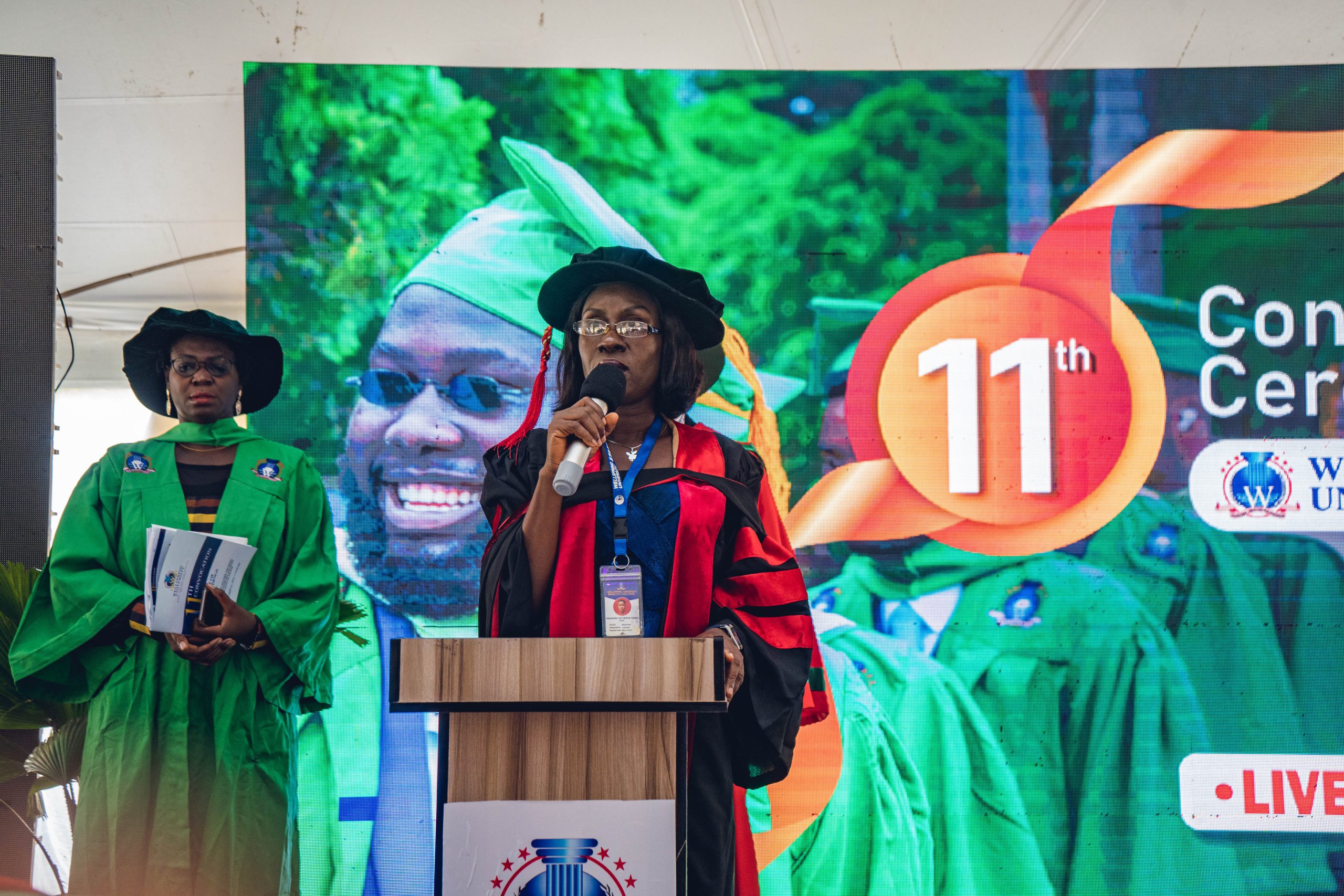
Dr. Henrietta OBUEH
Dr. Henrietta Obueh is a highly accomplished Senior Lecturer and academic administrator who currently serves as the Acting Head of Department for Biological Sciences and the Acting Director for the Centre for Leadership and Gender Studies at Wellspring University.
Education & Expertise
Dr. Obueh holds extensive educational qualifications across diverse fields:
- Ph.D. (2014): Food and Industrial Microbiology, University of Benin (UNIBEN).
- M.Sc. (2001): Environmental and Public Health Microbiology, University of Benin (UNIBEN).
- PGDE (2006): Postgraduate Diploma in Education, Ambrose Alli University, Ekpoma (AAU).
- B.Sc. Hons (1992): Microbiology (Second Class Upper Division), Ambrose Alli University, Ekpoma (AAU).
Academic Career
She commenced her academic career in 2001 at the College of Education, Ekiadolor, Benin, where she progressed through the ranks to attain the highest position of a Chief Lecturer in 2018. During her time there, she held significant administrative roles, including Head of Department for Biology and Director of the Environmental Education Unit.
Dr. Obueh joined Wellspring University on March 1st, 2024, and contributes her wealth of experience in teaching, research, and administration to the institution.
Research & Professional Affiliations
- Publications: Dr. Obueh is a prolific researcher with approximately fifty (50) scholarly articles published in reputable international and national journals.
- Professional Bodies: She is an active member of several prestigious professional organizations, including:
- Society for Applied Microbiology (SfAM/AMI)
- American Society for Microbiology (ASM International & ASM Global)
- Nigerian Society for Microbiology (NSM)
- Teachers Registration Council of Nigeria (TRCN)
- Science Teachers Association of Nigeria (STAN)
| Detail | Information |
| Designation/Position | HOD, Biological Sciences |
| Senior Lecturer | |
| Department/Faculty | Biological Sciences (Microbiology) / College of Science and Computing |
| Contact Email | obueh.henrietta@wellspringuniversity.edu.ng |
| Contact Phone | +234 805 611 2904 |